Every week, someone asks us how hard it is to "build something like Midjourney" or "add AI to our product." The honest answer is: calling an API is easy. Building a platform that users pay for, come back to, and trust with their data — that's a different category of work entirely. We've lived this firsthand building Wildmind AI, a multi-modal generative platform serving hundreds of concurrent users across image, video, music, and text generation.
This article is a technical reality check. If you're a founder, CTO, or product leader planning a generative AI product, here's what you're actually signing up for — and where teams underestimate the effort.
It's Not Just an API Wrapper
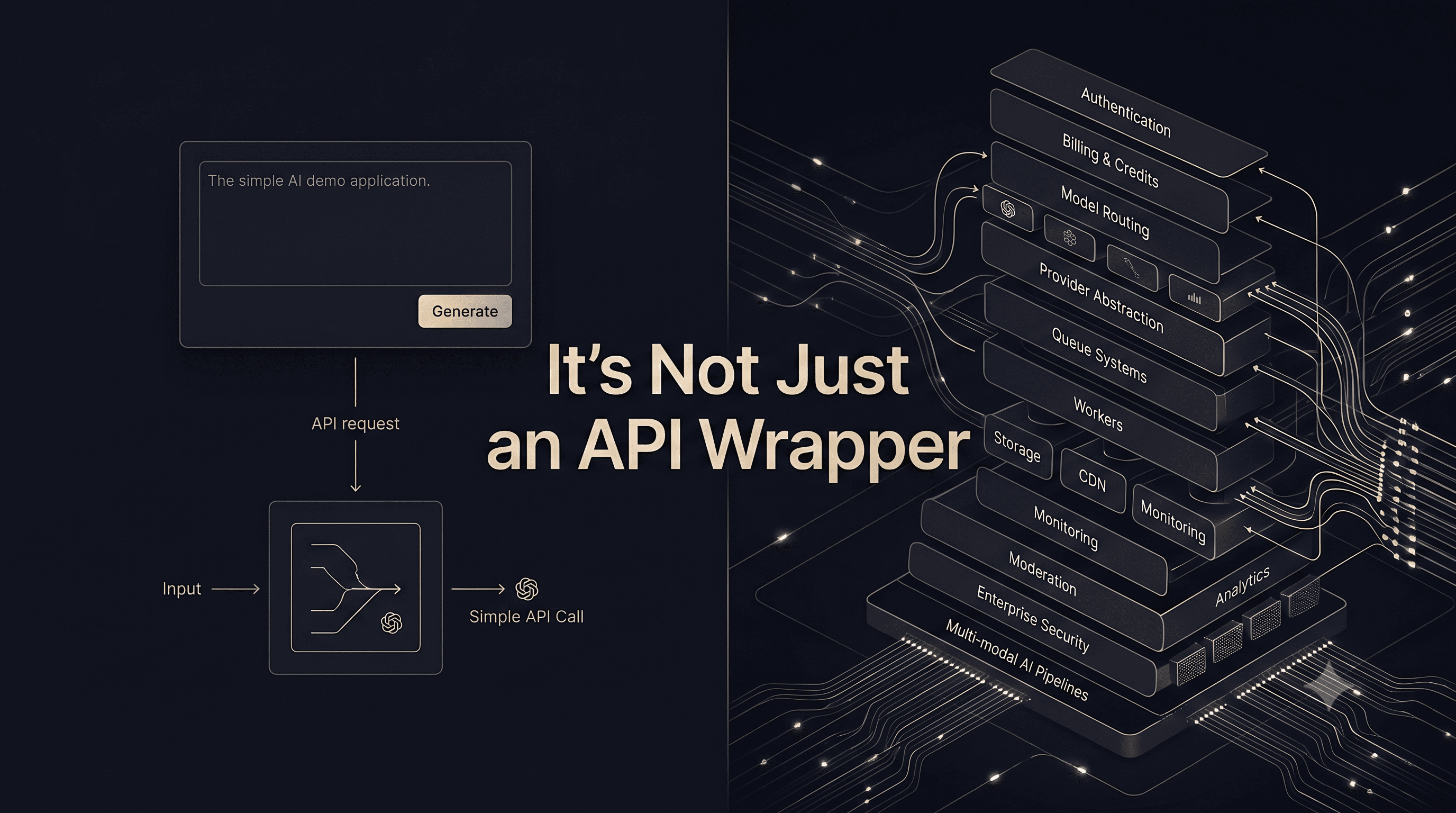
The demo version of a generative AI product is deceptively simple: a text box, a button, a call to OpenAI or Stability, display the result. Ship that in a weekend hackathon. Then try to handle 200 users generating images simultaneously, with different subscription tiers, failed jobs that need retry logic, and a model provider that changes pricing overnight.
A production platform needs a product layer (auth, billing, UX), an orchestration layer (routing requests to the right model with the right parameters), an execution layer (queues, workers, storage), and an observability layer (logging, cost tracking, error alerting). Skip any one of these and you'll rebuild it under fire six months later.
The Core Architecture Layers
Model orchestration and provider abstraction
You'll likely start with one provider. You won't end there. Model quality shifts, pricing changes, and outages happen. A proper orchestration layer abstracts providers behind a unified interface — so swapping from one diffusion model to another doesn't require rewriting your frontend. This includes parameter normalization, response formatting, fallback chains when a primary provider fails, and version pinning so a model update doesn't silently change output quality for paying users.
For multi-modal platforms, orchestration gets harder. Image generation, video generation, and LLM chat have different latency profiles, cost structures, and failure modes. Your gateway needs to understand all of them.
Credit systems and billing
Generative AI has variable cost per request. Flat subscription pricing requires a credit or token economy underneath — otherwise a power user generating 500 images a day destroys your margins. Building this means: atomic credit deduction (race conditions are real), usage metering per model type, rollover and expiry rules, top-up flows, and reconciliation with payment providers like Stripe or Razorpay.
We learned on Wildmind AI that billing bugs are trust bugs. Users who lose credits to a failed generation they didn't cause will churn faster than from any missing feature.
Queue management and async pipelines
Image and video generation aren't instant. Even fast models take seconds; video can take minutes. Your architecture must be asynchronous: accept the request, enqueue a job, return a job ID, poll or push status updates, store the result, and serve it via CDN. That means message queues (Redis, SQS, or similar), worker processes, dead-letter handling, timeout policies, and progress UI that keeps users informed without hammering your API.
At scale, queue depth becomes a product feature. Priority tiers for paid users, fair scheduling for free tiers, and backpressure when providers throttle you — all of this is engineering work that no API SDK gives you for free.
Infrastructure Requirements
Storage is the hidden cost. Generated media adds up fast — 10,000 users each storing 50 images means millions of files. You need object storage (S3 or equivalent), CDN delivery, lifecycle policies for expired content, and thumbnail generation pipelines. Compute needs are spiky: burst capacity during peak hours, idle cost during quiet periods. Serverless workers help, but cold starts and provider-side rate limits still require careful tuning.
Monitoring is non-optional. Track per-model latency, error rates, cost per generation, queue wait times, and storage growth. Set alerts before users notice degradation. We reduced average pipeline latency by 40% on Wildmind AI not through model changes, but through infrastructure optimization we only found because we were measuring everything.
Security, Compliance, and Data Handling
Users will upload sensitive content — product photos, internal documents, personal images. Your platform needs upload validation, content moderation (automated and/or human review), secure storage with access controls, and clear data retention policies. Prompt logging is a double-edged sword: useful for debugging, dangerous if it captures PII. Design your logging strategy before launch, not after a compliance review.
For enterprise clients, add SSO, role-based permissions, audit trails, and optionally private model deployments or VPC peering. These aren't phase-two features if you're selling to regulated industries — they're table stakes.
Building vs Buying Components
Not everything needs to be custom. Auth can be Clerk or Auth0. Payments can be Stripe. Media storage can be S3 + CloudFront. But the orchestration layer, credit economy, and job pipeline are your core IP — and where most off-the-shelf tools fall short. Buy commodity infrastructure; build the parts that define your product's behavior and economics.
Teams that underestimate this split often spend three months integrating a "platform" that handles auth beautifully but can't manage a multi-step generation workflow. Evaluate components against your specific modality mix, not generic feature checklists.
What Wildmind Learned Building Wildmind AI
We shipped six distinct generation pipelines — image, video, music, ad creative, song, and product photography — on a shared orchestration backbone. The hardest problems weren't model-related. They were credit race conditions, provider adapter maintenance, queue fairness under load, and keeping the UX responsive while jobs ran asynchronously.
That experience is why we tell clients the truth about timelines. A credible v1 generative AI platform — single modality, basic billing, production auth, async jobs — is a 10–14 week engagement with a senior team. Multi-modal, enterprise-ready, with moderation and analytics: think 5–7 months. Anyone promising the full vision in six weeks is selling a demo.
If you're planning a generative AI platform and want a partner who's already solved these problems in production, we should talk. We'll tell you what you actually need — and what you can defer.
Wildmind builds production generative AI through our Generative AI service, supported by SaaS product development and web and mobile engineering. We apply this stack across sectors including e-commerce and manufacturing. Get in touch to discuss your platform architecture with our senior engineering team.
Planning a generative AI product?
See how we built Wildmind AI — or talk through your architecture with our team.