Wildmind AI
A full-stack generative AI SaaS platform combining image, video, music, ad, song, and product generation in a unified creative studio, with an intelligent assistant, integrated payments, and a credits-based economy.
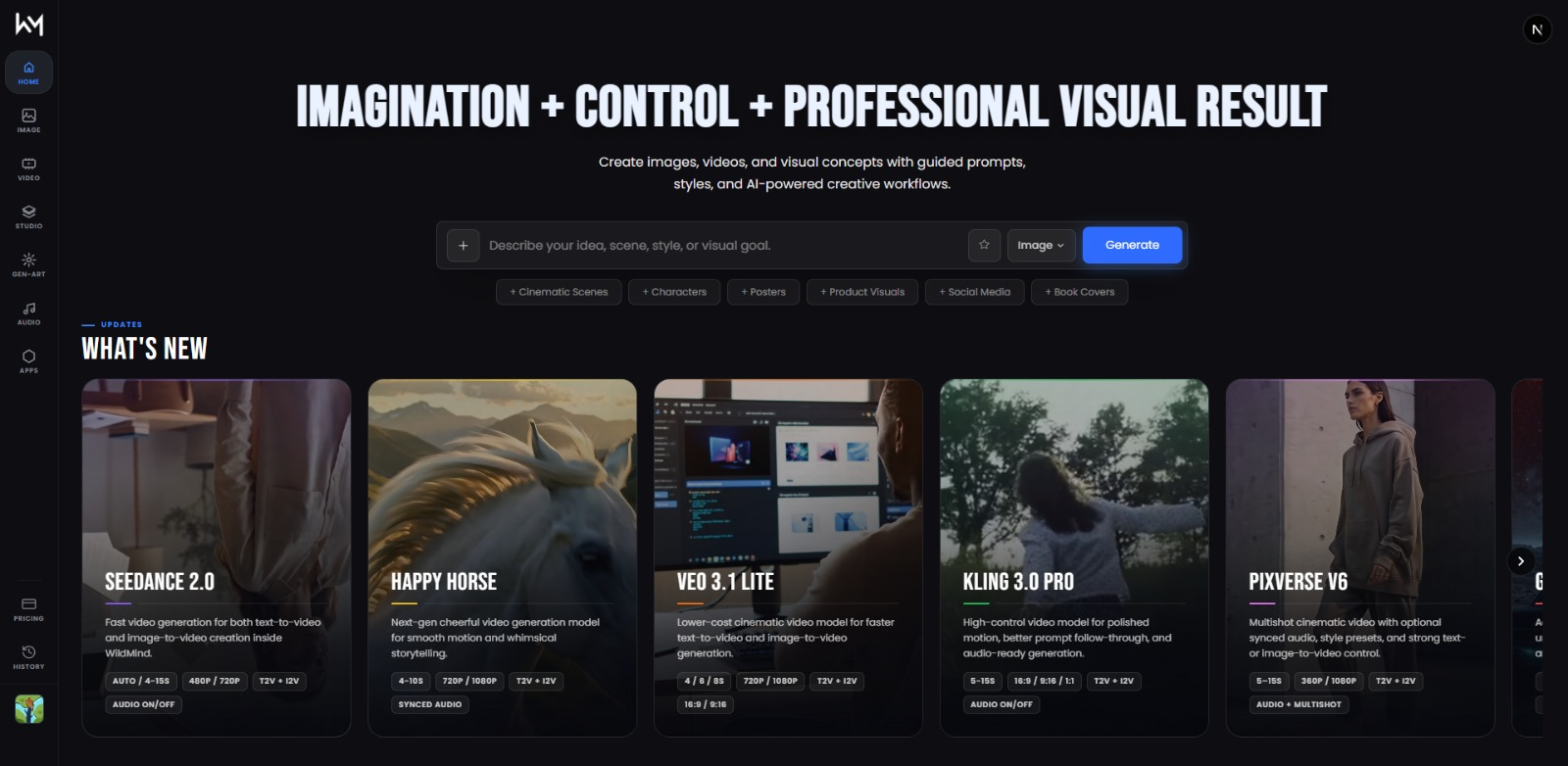
A full-stack generative AI SaaS platform combining image, video, music, ad, song, and product generation in a unified creative studio, with an intelligent assistant, integrated payments, and a credits-based economy.
Creators and businesses needed to work across multiple disconnected tools (one for images, another for video, another for music) with no unified workflow, no shared asset library, and no intelligent orchestration layer. Every provider had a different API, different pricing model, and different quality profile. Building on top of them required constant re-integration.
The challenge was to build a single platform that abstracted all of this complexity, giving users a smooth creative studio while giving the business full control over provider routing, cost management, and quality optimization.
We designed and built Wildmind AI from the ground up: a multi-tenant SaaS platform with a unified generation studio, an intelligent assistant that orchestrates multi-step creative workflows, a credits-based economy with Razorpay integration, and a provider abstraction layer that routes requests to the optimal AI model based on task type, cost, and latency.
Unified interface for image, video, music, ad creative, song, and product generation, all from a single workspace with shared asset management.
A conversational assistant that understands creative intent, gathers requirements, proposes workflows, and executes multi-step generation pipelines on behalf of the user.
Abstraction layer routing requests across Fal AI, Runway ML, MinMax, BFL Flux, and OpenAI, with automatic fallback, cost optimization, and latency monitoring.
Flexible credit system with Razorpay integration, subscription tiers, usage tracking, and real-time balance management across all generation types.
Bull-based job queues handling 2,000+ daily AI requests with priority lanes, retry logic, and real-time status updates via WebSockets.
Automated S3 pipeline managing 10,000+ media assets with CDN delivery, thumbnail generation, and organized per-user asset libraries.
Microservices architecture with a NestJS API gateway, async job queues, Redis caching, and PostgreSQL with Prisma ORM. The frontend is a Next.js App Router application with Redux Toolkit for state management and real-time updates via WebSockets.
Platform handles 500+ simultaneous users with sub-second response times on the UI layer and async processing for generation tasks.
Provider routing and Redis caching reduced average generation response latency by 40% compared to direct single-provider integration.
Unified adapter pattern reduced time to integrate a new AI provider from weeks to days, a 60% reduction in onboarding effort.
Queue-based microservices process 2,000+ daily generation requests with 99.9% completion rate and automatic retry on transient failures.