QuickBooks Online
100+ integration patterns. App-store-ready OAuth. Certified-style QBO entity sync.
A multi-platform sync layer so product and ops teams connect once and keep vendors, invoices, and payments aligned across the world’s leading accounting and ERP systems — QuickBooks Online & Desktop, Xero, Sage, NetSuite, Business Central, MYOB, FreshBooks, Zoho Books, Wave, ClearBooks, Odoo, and more — without brittle one-off connectors or expensive per-user iPaaS fees.
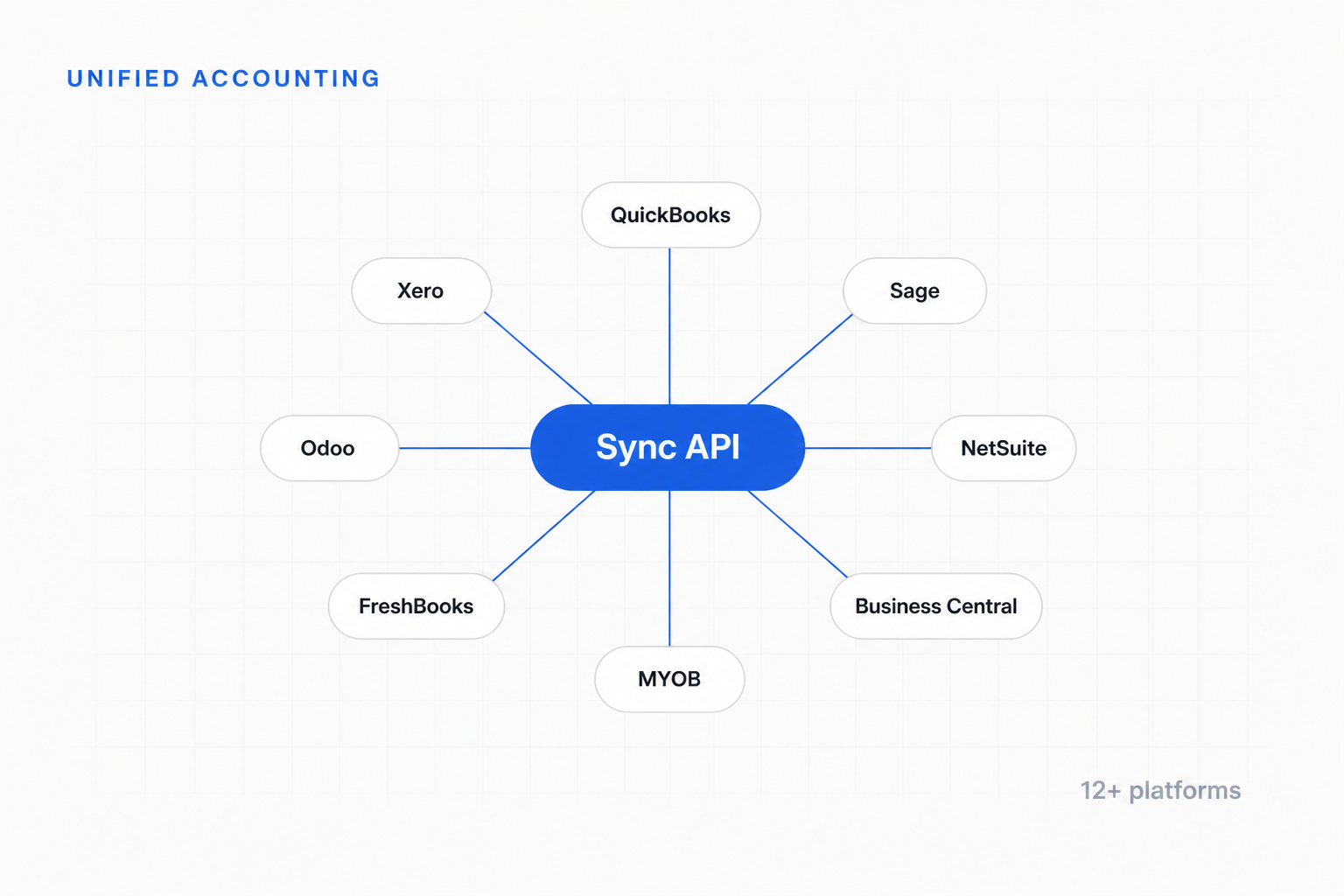
Finance and product teams were juggling CSV exports, fragile custom scripts, and expensive third-party connectors just to keep vendors, invoices, and payments consistent across QuickBooks Online, QuickBooks Desktop, Xero, Sage, NetSuite, Business Central, and a long tail of regional ledgers. Each platform had its own auth model, rate limits, and entity shapes — so “sync” usually meant partial updates, silent failures, and month-end fire drills.
Per-user iPaaS pricing scaled with customers, not value. Tokens expired mid-job. Mapping GL codes and vendor IDs by hand invited duplicates. The business needed a owned integration layer: one sync engine, modular adapters, and credentials that never leaked.
Operators re-entered the same vendor and invoice data into multiple accounting systems, burning hours and creating mismatches that only showed up at close.
Third-party integration platforms charged per user and limited how deeply entities could be mapped — expensive at scale and shallow when edge cases appeared.
OAuth tokens expired mid-batch; partial syncs left ledgers half-updated with no reliable retry or dead-letter path for failed events.
Each new platform meant another one-off integration. Onboarding NetSuite after QuickBooks should have been configuration — not a rewrite.
WildMind designed a bi-directional Unified Accounting Integration platform: a shared sync core with modular adapters for QuickBooks Online, QuickBooks Desktop, Xero, Sage (50 / Intacct / Business Cloud), NetSuite, Dynamics 365 Business Central, MYOB, FreshBooks, Zoho Books, Wave, ClearBooks, and Odoo. Vendors, invoices, and payments flow through normalised entity mappers; OAuth 2.0 credentials rotate automatically; workers run on AWS Lambda so traffic spikes do not take the ledger offline.
Scheduled jobs and webhook triggers keep systems near real-time. Failed events land in a retry queue with visibility for operators. The result is owned integration logic — deeper mappings, predictable cost, and zero token-leak incidents in production.
Vendors, invoices, and payments sync both ways with conflict-aware upserts so neither system becomes a silent source of duplicates.
Each ledger plugs in behind a common interface — from QuickBooks and Xero to NetSuite, Sage, Business Central, and Odoo — so adding a provider is an adapter, not a fork of the core.
Secure token storage, refresh, and rotation across platforms. Credentials never touch the client; expiry is handled before jobs fail mid-flight.
Cron-style Lambda schedules plus webhook hooks keep syncs flowing whether the source system pushes or the worker pulls on interval.
Failed events are isolated, retried with backoff, and surfaced for ops review — partial syncs no longer vanish into log noise.
Operators can inspect connection health, last successful sync, and entity counts without opening four different accounting UIs.
Need a platform not listed here? We have connected SaaS products to 50+ accounting and ERP systems — talk to us about your stack.
100+ integration patterns. App-store-ready OAuth. Certified-style QBO entity sync.
Legacy and modern connectivity. Desktop-to-cloud migration expertise.
Invoice, contact, and payment sync. Built for UK, AU, and accounting-forward teams.
Sage 50, Sage Intacct, Sage Business Cloud. Multi-version support.
SuiteTalk / REST. Custom records and saved-search-driven ERP sync.
Dynamics 365 Business Central API. Microsoft finance & operations stacks.
Australian market accounting sync for SMB and mid-market SaaS.
Invoice and expense sync. Time-tracking-friendly service workflows.
Zoho Financial Suite connectivity for products already in the Zoho ecosystem.
Free accounting platform integration for SMB-focused SaaS products.
UK market accounting platform. MTD-aware compliance patterns.
Open-source ERP integration. Custom module hooks for Odoo finance.
The stack is intentionally lean: an API layer fronts Lambda workers that read and write PostgreSQL, pull secrets from a secured vault, and call provider APIs through rate-aware adapters. Redis absorbs bursty rate-limit windows so a noisy tenant cannot starve the fleet.
Vendors, invoices, and payments move through automated pipelines instead of copy-paste between accounting UIs.
Serverless workers absorb real-time financial traffic without provisioning a fleet that sits idle overnight.
QuickBooks Online & Desktop, Xero, Sage, NetSuite, Business Central, MYOB, FreshBooks, Zoho Books, Wave, ClearBooks, and Odoo share the same sync engine — new adapters plug in without rewriting the product.
OAuth rotation and vaulted secrets kept credentials off clients and out of logs across the production run.
Replacing rented connectors with owned adapters cut recurring iPaaS spend and unlocked deeper entity mappings.
Lambda auto-scaling kept sync jobs healthy under load — no overnight batch window that blocked the next business day.